All-on-4 Dental Implants: Who Owns the Name, How It Works & What It Costs
 Written by Michael Seutin,
founder — former nurse, researching dental pricing abroad.
Written by Michael Seutin,
founder — former nurse, researching dental pricing abroad.
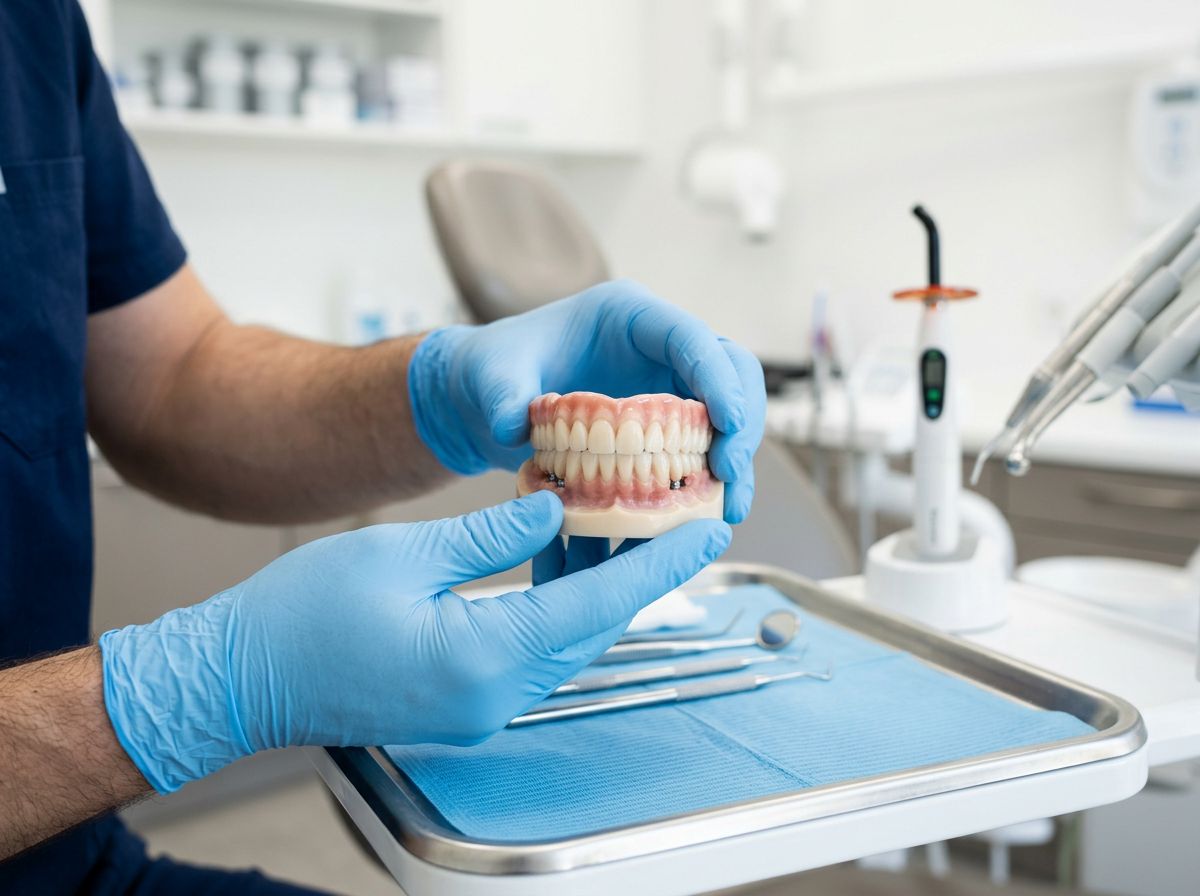
All-on-4 replaces a full arch of teeth — upper or lower — on just four implants, with the back two angled to grip the strongest bone and avoid grafting. The protocol was developed by Dr. Paulo Maló with Nobel Biocare; the first documented patient was treated in 1998. You leave surgery with fixed provisional teeth the same day. Abroad it is a fraction of the $20,000–$30,000 a US arch runs — how large a fraction depends on the country, the bridge material and the implant brand. The per-country figures below are read from our clinics' own published lists, with the number of clinics behind each one, rather than averaged into a single headline number.
Get free quotes from vetted clinics
Tell us roughly what you need — we pass it to vetted clinics and you compare offers. Free, no obligation.
how four implants hold a full arch
Two implants go in vertically at the front of the jaw, two are tilted about 45° at the back — the tilt anchors them in dense front-jaw bone and sidesteps the sinus (upper) and nerve (lower). A full bridge of teeth screws onto those four points. The design exists precisely for jaws with bone loss at the back, which is why most All-on-4 cases skip the bone grafts that traditional full-mouth implants would need.
who it's for
All-on-4 is for an arch that's already lost — most teeth missing, failing or beyond saving — and for denture wearers who want fixed teeth back. It is not the tool for a few gaps in an otherwise healthy arch: single implants preserve the good teeth. And if your teeth are treatable, treating them is almost always the better first move — extracting a workable arch to sell a package is the full-mouth version of the "turkey teeth" problem.
where the name comes from, and why your clinic may not use it
All-on-4 is not a generic dental term — it is a registered trademark of Nobel Biocare, listed on the company's own trademark page with the generic description "treatment concept". The protocol behind it was developed by Dr. Paulo Maló, a Portuguese dentist, in the early 1990s with support from Dr. Bo Rangert of Nobel Biocare; Maló treated the first documented patient in 1998 and Nobel Biocare launched it commercially in 2004. (If you have been searching "all on 4 palo alto" and getting dental practices in California, the name you want is Paulo Maló — the search engines hear it as the town.) That history is why the same treatment reaches you under several names. A clinic may describe its full-arch work as all-on-4, all-on-6, full-arch fixed, or same-day teeth, and the wording it chooses is a fact about its marketing rather than a verdict on its dentistry. We record which implant systems each clinic names on its own pages; we do not know, and do not claim to know, which clinics hold a licence to the mark. What is worth doing with the name is simple: ask which implant system is going in your jaw and get the answer in writing, because that is the part that changes both the price and what a dentist at home can service later.
the timeline abroad
Trip one: extractions if needed, the four implants, and a fixed provisional bridge — usually acrylic — within a day or two. Then 3–6 months of healing at home while bone locks the implants in place. Trip two: the final bridge, fitted and calibrated. Clinics advertising the *final* zirconia bridge inside one week are compressing the step that protects the implants — ask what's provisional, what's final, and what happens if the provisional breaks at home.
acrylic vs zirconia — the price gap explained
The bridge material is why one All-on-4 quote is double another with the same four implants.
| material | best for | typical lifespan | cost |
|---|---|---|---|
| Acrylic / hybrid | provisional bridges; budget final bridges | ~5–10 years; wears and stains | low end of every range |
| Zirconia | final bridges — strength and stain resistance | 10+ years with care | the top of the range; worth pricing separately |
implant brands compared
The same implant systems compared on the implants page carry All-on-4 — and "All-on-4®" is Nobel Biocare's trademarked protocol, so budget quotes are often an all-on-four-style case on other brands. That can be fine; what matters is that the brand of the four implants is named in writing, not sold as a mystery bundle.
| brand | tier | origin | in our directory | what to know |
|---|---|---|---|---|
| Straumann | premium | Switzerland | 22 clinics | Premium Swiss implant system with the longest clinical track record — the reference point for high-end implant pricing. |
| Nobel Biocare | premium | Sweden | 16 clinics | Premium implant brand, inventor of the All-on-4 protocol. Widely offered by top clinics. |
| Zimmer Biomet | premium | United States | — | US premium implant system, common in clinics marketing to American patients. |
| Neodent | mid | Brazil | 12 clinics | Straumann Group's value-to-mid brand — the workhorse implant at Turkish package clinics. |
| Bicon | mid | United States | 6 clinics | US short-implant system (Boston) — placed where bone height rules out standard fixtures. |
| Osstem | mid | South Korea | 5 clinics | Leading Korean implant brand — strong clinical data at a mid-tier price. Very common in Turkey. |
| Medentika | mid | Germany | 4 clinics | Straumann Group's German mid-range system, common in Antalya per-brand price lists. |
| MegaGen | mid | South Korea | 3 clinics | Korean mid-tier system, popular for its AnyRidge design in immediate-load cases. |
| MIS | mid | Israel | 1 clinics | Israeli implant system, widely placed at Mexican and Turkish value-tier clinics; priced a tier below Nobel and Straumann on the lists that carry all three. |
| Dentium | mid | South Korea | — | Korean implant brand offered as a value-to-mid option at many tourism clinics. |
| Hiossen | mid | United States | — | Osstem's US-market brand — mid-tier, widely used in Mexico clinics. |
| Generic | value | — | 1 clinics | Unbranded or economy implant fixtures. Lowest price, least clinical provenance — the value tier to compare against. |
what it costs by country
Home-market figures are published averages, sourced below. The destination rows underneath are read from our own clinic records at the moment you load this page.
in our directory now: Mexico — 26 verified clinics from $7,998 · Turkey — 5 verified clinics from $3,810
what the same arch costs on a different implant system
These are the clinics that publish more than one price for the same arch, split by the implant system going in. It is the brand premium in the clinic's own numbers, on the date we read its price list — not our estimate of what a brand is worth. Where a clinic prices in its own currency we lead with that figure.
| as the clinic lists it | brand | price |
|---|---|---|
| Neodent + 12 zirconium crowns | Neodent | £3,000 ≈ $3,810 |
| Full Swiss | no single brand named | $6,810 |
At this clinic the gap between Neodent + 12 zirconium crowns and Full Swiss is $3,000, same treatment.
We have not confirmed that all of these figures cover the same finished treatment — read the gap as indicative and ask the clinic what each price includes.
| as the clinic lists it | brand | price |
|---|---|---|
| Acrylic hybrid fixed denture | no single brand named | $8,110 |
| Nobel | Nobel Biocare | $8,950 |
| Straumann | Straumann | $9,710 |
At this clinic the gap between Acrylic hybrid fixed denture and Straumann is $1,600, same treatment.
We have not confirmed that all of these figures cover the same finished treatment — read the gap as indicative and ask the clinic what each price includes.
| as the clinic lists it | brand | price |
|---|---|---|
| Neodent implants + temporary denture | Neodent | £2,050 ≈ $2,605 |
| Straumann | Straumann | $4,190 |
At this clinic the gap between Neodent implants + temporary denture and Straumann is $1,585, same treatment.
We have not confirmed that all of these figures cover the same finished treatment — read the gap as indicative and ask the clinic what each price includes.
verified clinics for this procedure
Lowest published price first. Every listing is checked against the clinic's own sources — what verified means.
Stom Dental Centre
verifiedAntalya, Turkey
$435 per implant, complete
SOTA Dental Los Algodones
verifiedLos Algodones, Mexico
$1,399 per implant, complete
SOTA Dental Tijuana
verifiedTijuana, Mexico
$1,399 per implant, complete
Algodones Dental Center
verifiedLos Algodones, Mexico
$1,500 per implant, complete
Dental Solutions Tijuana
verifiedTijuana, Mexico
$1,545 per implant, complete
Cancun Dental Design
verifiedCancún, Mexico
$1,600 per implant, complete
related
- Dental implants explained — the single-implant version of this page
- Implant brands compared — Straumann, Nobel Biocare, Neodent and the rest, by tier
- Mexico or Turkey for dental work — full-arch prices side by side, with the sample behind each
- Dental work in Mexico — Los Algodones full-arch pricing
- Cost calculator — estimate arches in 10 seconds
common questions
Is All-on-4 permanent?
The bridge is fixed — only a dentist removes it — and the implants are designed to last decades. The bridge itself is a wear part: acrylic typically needs replacing in 5–10 years, zirconia lasts longer. Budget for that when comparing quotes.
What's the difference between All-on-4 and dentures?
Dentures rest on the gums and come out at night; All-on-4 is screwed to implants in the bone, so it doesn't move, doesn't cover the palate, and keeps stimulating the jawbone — which slows the bone loss dentures allow.
Do you really get teeth the same day?
You get fixed provisional teeth the same day or the day after — that part is real. The final bridge comes after 3–6 months of healing. A quote that skips the provisional/final distinction is hiding either a second trip or a rushed final.
All-on-4 or All-on-6 — which is better?
All-on-6 spreads the load over six implants — more support where bone allows it, at a higher price. Neither is universally better; it's a surgical judgment based on your bone volume and bite. Be wary of a clinic that recommends one without imaging.
Is All-on-4 a brand name?
Yes. All-on-4® is a registered trademark of Nobel Biocare, listed on the company's own trademark page under the generic description "treatment concept". That is why the same full-arch treatment reaches you as all-on-4, all-on-6, full-arch fixed or same-day teeth depending on the clinic. The wording a clinic chooses tells you about its marketing, not about the quality of its dentistry — the question worth asking is which implant system is going in, in writing.
Who is Paulo Maló?
The Portuguese dentist who developed the protocol. Nobel Biocare credits Dr. Paulo Maló with leading its development in the early 1990s alongside Dr. Bo Rangert, treating the first documented patient in 1998; Nobel Biocare launched it commercially in 2004. If you have searched "all on 4 palo alto" and found dental practices in California, Paulo Maló is the name you were reaching for.
sources
- Nobel Biocare — trademark list (All-on-4® is a registered mark)
- Nobel Biocare — 25 years of the All-on-4® treatment concept (Dr. Paulo Maló)
- Real Dental Costs — US full-arch averages (ADA / FAIR Health)
- Dental Solutions Los Algodones — published price list
- Turkey Dental Clinic — 2026 implant cost breakdown
Educational overview, not medical advice — treatment decisions need an examination. Ranges are published figures for comparison, not quotes.